The Defense Department has been compelled to pay $1.8 million in legal fees to Liberty Counsel, the firm representing courageous service members who challenged the unjust COVID-19 vaccine mandate. A Florida U.S. District Court judge recently awarded this settlement, marking a significant win for those who stood for their religious freedoms.
The lawsuits, brought forth by 48 service members, including Navy SEALs and officers from all branches of the military, challenged the Defense Department’s violation of their right to religious freedom by denying their requests for religious exemptions from the COVID-19 vaccine.
The Navy SEALs’ lawsuit, initially filed in 2021, was a testament to the Defense Department’s infringement on religious liberties. Although Congress passed a law in December to end the vaccine mandate, the legal battles persisted. The recent settlement is a victory for the federal right to a religious exemption and a resounding defeat for the vaccine mandate.
Mat Staver, chairman of Liberty Counsel, expressed, “For two years, Liberty Counsel has been defending the brave men and women of the U.S. military against Joe Biden’s unlawful COVID shot mandates.”
It is essential to clarify that the settlement funds are solely designated for Liberty Counsel to cover attorney fees and lawsuit-related costs; none of it goes to the plaintiffs.
These service members asserted religious objections to the vaccine, citing concerns about the vaccine’s production methods. Specifically, they raised concerns about the use of cell lines from fetuses aborted in the 1970s and 1980s, despite the fact that the vaccines do not contain any aborted fetal tissue, as confirmed by the Food and Drug Administration.
It is crucial to understand that a settlement is not an admission of guilt or wrongdoing by either party. This ruling has far-reaching implications and demonstrates the commitment of these servicemen and women to uphold their constitutional rights.
Approximately 17,000 service members refused the vaccine, leading to over 8,400 discharges for their principled stance. These include 3,717 Marines, 2,041 Navy sailors, 1,841 Army soldiers, and 834 Air Force and Space Force members. More than 1,000 service members received religious exemptions before the mandate was lifted.
Since the vaccines received emergency authorization for use in the U.S., the Defense Department has successfully vaccinated over 2 million service members and nearly 350,000 DoD civilian employees, contributing to the ongoing fight against the COVID-19 pandemic.
The Pentagon has recorded 740,942 cases of COVID-19 among troops, family members, DoD employees, and contractors, resulting in 690 deaths, including 96 service members. However, the Pentagon has chosen not to comment on this recent settlement.
Service members discharged for vaccine refusal have primarily received general discharges, granting them access to health care and disability benefits from the Department of Veterans Affairs while making them ineligible for education benefits. These discharged service members can seek upgrades and rejoin the service, but the number of returnees remains minimal.
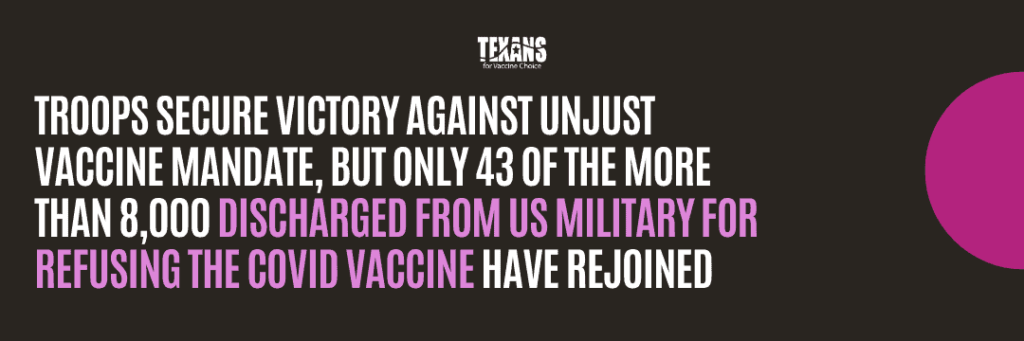
However, after the official repeal of the COVID-19 vaccine mandate in the military, the number of service members seeking to rejoin is far lower than expected. Only 43 of the over 8,000 service members discharged for refusing the vaccine have expressed their desire to return to the military. This reveals that the vaccine mandate might not have been as detrimental to military recruitment and retention as some had claimed.
The vaccine mandate was in effect for just 15 months, from August 2021 to January 2023, when it was revoked by law as part of the National Defense Authorization Act. This historic reversal of a vaccine requirement marked a significant turning point for the U.S. military.
In the eight months following the repeal, only 19 soldiers have reenlisted in the Army, with 12 returning to the Marines. The numbers are even more limited for the Air Force and Navy, where only one and two service members have rejoined, respectively.
While some Republicans argued that the vaccine mandate had negative effects on military recruitment and retention, the Defense Department states that all military services exceeded their retention goals for the first ten months of the 2023 fiscal year. This achievement is noteworthy, especially in light of the challenges faced in recruiting new service members.
J. Stephen Morrison, director of the Global Health Policy Center at the Center for Strategic and International Studies, described the number of service members seeking to return as “minuscule.” He noted that the vaccine mandate issue may be put to rest, as the data suggests it was not a significant hurdle to recruitment or retention.
The vaccine mandate, while controversial, did not appear to have a substantial impact on the overall military landscape. Experts speculate that younger service members may have pursued other career opportunities, while older service members might have decided to retire sooner than planned.
Kate Kuzminski, the director of the Military, Veterans, and Society Program at the Center for a New American Security, suggested that the vaccine mandate may have served as a means for some service members to exit the military when they had no other options for breaking their commitments. Additionally, service members with longer tenures may have found it challenging to explain a gap in their resume when seeking promotions, leading them to forego rejoining.
Overall, it seems that the repeal of the vaccine mandate has not led to a significant resurgence in service member returns, as only small numbers have chosen to do so.